

Therapy is a big investment! When your session is virtual, prepare yourself and your space in order to maximize the session’s benefit. Most importantly, secure your capacity for two psychotherapy essentials: attentiveness and disclosure.
Secure your capacity for two psychotherapy essentials: attentiveness and disclosure.
Your therapy session is a time to take stock of your heart, mind, and body and describe what’s showing up for you to your therapist. Are you ready? Here are three things to keep in mind to clear a space in your environment and in yourself:
1. Find some privacy.
Are you able and ready to share your deepest point of pain? Please let your therapist know if you need help securing a private location for your therapy appointment. Your therapist can help you think creatively about how to solve this problem. Solutions could include doing the session in your car, sound-proofing a room, setting boundaries with children, using technology –such as holding the microphone close to your mouth or using a chat function. This is your time. You need to be able to say what is on your mind and heart without fear of being overheard.
2. Clear your mind.
Prepare not only a quiet, distraction-free room but also an unaltered mind. Some of the biggest therapy-interfering internal culprits are
- Grogginess– Wake up at least 30 minutes before your session. Seek to sustain alertness throughout your session, which would optimally occur out of bed in an upright position. If you are sleepy, tell your therapist! Stand up, take your therapist on a walk with you. (If you have a sleep disorder, this may be the very reason you are seeking treatment. We understand. Let your therapist help you get creative to stay alert and just do your best.)
- Work Brain– Seek to build 15-20 minutes of transition time before and after your session (or, hey, 5 minutes on both sides can do wonders and is significantly better than no transition time). In-person therapy has this transition time built in during the drive. For virtual therapy, you have to schedule it and give yourself permission to take it in order to clear your mind before and consolidate after.
3. Focus in.
Are you able and ready to pay close attention? To your therapist, yes. But also, mostly, to yourself. You finally have a therapist; you finally committed to therapy. You deserve this. Allow yourself– for one hour a week — to be fully immersed in the experience you carved out for yourself. Focus on your session and your session alone. If you are struggling with the urge to multitask in any way (driving, cooking, eating, caring for children, texting, surfing the web), candidly share this with your therapist for mutual support and accountability. We have all been there! In the early days of virtual therapy I had a client ask me, “Dr. Stone, are you sitting on one of those yoga balls?” Indeed, I was sitting on one of those yoga balls. I did not even realize I was bouncing– probably was not at my most centered– and the movement was distracting my client. Another time a client shared with me that they could tell I was writing and would prefer my undivided attention. . . . Thank you! (Of course you would!) There is a learning curve here. We are all pioneers in this brave new world.
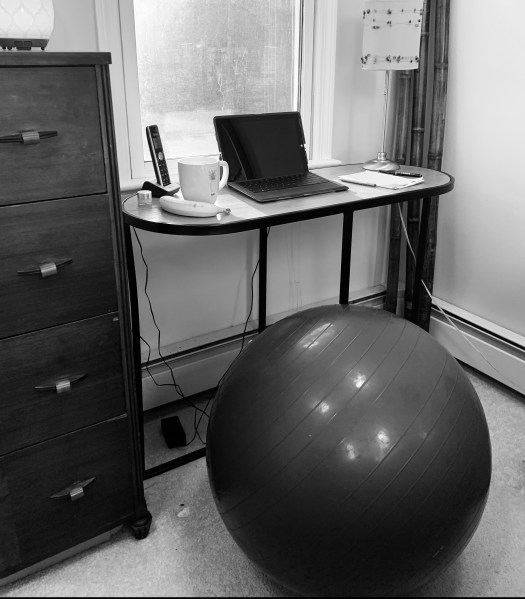
Ensure a continued rich, high-quality experience from home by making the effort to obtain privacy, transition time, and focus when doing virtual therapy. You will do your best work in this quiet, clear, and nonjudgmental space.

About Me
I’m Kristen Stone, a licensed clinical psychologist, behavioral sleep specialist and couple therapist with a passion to protect and grow empirically-based wellness services through training, research, and innovation. A born and bred southerner, I have found the Northeast a gracious host of my life and work for over 15 years. New England summers, falls, and– yes! –winters are magical. Then Tennessee springtime calls me home.
Subscribe to My Blog
Get new content delivered directly to your inbox.
 Kristen Stone, PhD