
Peeking Beneath Sharing the Covers
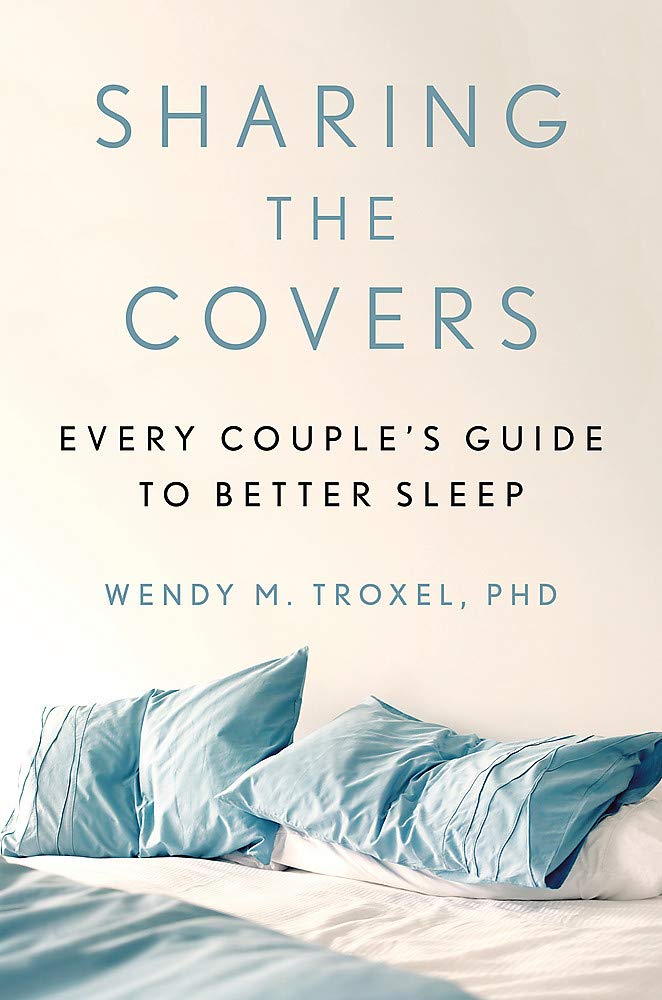
Happy to report that Wendy Troxel’s new book, Sharing the Covers: Every Couple’s Guide to Better Sleep, is as engaging as her sleep conference presentations, which I’ve had the good fortune to hear on occasion over the years. Sharing the Covers is part educational, on the importance of prioritizing sleep among couples, and part instructional on how to do so—whether sleeping together or apart. She jumps right into the (hot)bed of the “sleep divorce;” she has no love for the loaded term in reference to a couple’s decision to sleep apart. (The first time I heard the term was in this New York Times article.) Regarding couples sleeping together or apart, different strokes for different folks according to Troxel. She emphasizes that how couples come to this decision is far more important than what they decide.
Sharing the Covers is well-structured. Each chapter is independent; readers do not have to start at the beginning or read every chapter. Chapters also end with Shared Sleep Action Plans with quizzes, discussion questions, and activities. Other bright spots include the rich history on cultural sleeping arrangements across the ages and Troxel’s adequate and helpful guidance around child and family sleep issues. Delightful, too, is learning from an expert that feels approachable. A relatable scholar, Troxel opens up about her initial decision to co-sleep with her babies and recounts driving away from the gas station on one sleep-deprived occasion with the pump still attached to her car. This authentic self-disclosure combined with an incorporation of research at a dose that is entertaining and natural yields a unique, refreshing voice.
Correlations between sleep loss and risk factors are presented as fodder for worry for both individuals in relationships and for imperfect sleepers, which is a bit of a damper. The mention of a correlation between sleep deprivation and decreased testosterone in men, for example, is followed by the warning that for those intending to plan for a family “it is time to start thinking about your sleep.” The study, though, was of men randomly assigned to only five hours of sleep nightly, considerably less cumulative sleep than that obtained by the average man. The implication of the long list of correlations between sleep loss and risk factors for dysfunction is that couples experiencing these risk factors need to fix their sleep to fix their relationship. Critical? It could be due to lack of sleep. Contemptuous? Could be lack of sleep. Not funny enough? Lack of sleep. Stonewalling? You guessed it. . . Defensive? . . . It goes on. But correlation doesn’t equal causation (cue Research Methods 101); there could be about a hundred other contributors to these relationship risk factors.
Considerable attention is also given to the importance of getting more sleep, which while seemingly benign, is the kind of messaging that spooks people with insomnia. Broad-sweeping public health teasers can bombard and consume their minds. Think of “when you sleep better you look better” and “most adults need eight hours of sleep” as the creepy clowns of the insomniac’s circus. These individuals are not sleepless by choice. If you are on the short end of the eight-hour bell curve, a biologically short-sleeper, however hard you try to get that much sleep, you won’t. In fact, the harder you try, the less you sleep. A word to the (insomnia) wise: The studies cited in this book on sleep loss are of good sleepers whose sleep is intentionally shortened for the purpose of the study. The consequences of dramatically curtailed sleep among good sleepers do not necessarily generalize to people with insomnia. In other words, dear ones with insomnia, she’s not talking to you here. Alas, few good reads are without a cautionary tale or two.
Juiciest Morsel?
There are many tantalizing features, but my favorite is Troxel’s “pillow talk,” her gentle yet compelling reminder of what can happen when you lie next to your lover, why we sleep together, what it is all about at the end of the day. She includes an Esther Perel quote about how in the 21st century the last thing we stroke before bed and the first thing we stroke in the morning is. . . our phone. (Am I the only one crying a little?) Troxel advises that regardless of our decision to sleep together or apart, the intimate ritual of pillow talk– that time of closeness physically and emotionally, however brief–is worth protecting and cherishing.
On going to bed with our phones (in all senses of the phrase): “The last thing we stroke is our phone. The first thing we stroke is our phone.”
Esther Perel
The Nod.
I recommend Sharing the Covers for couples struggling with their shared or family sleep environment or routine. Troxel’s book is solution-focused, well-designed, entertaining, and informative.
Happy reading and sweet dreams.

About Me
I’m Kristen Stone, a licensed clinical psychologist, behavioral sleep specialist and couple therapist with a passion to protect and grow empirically-based wellness services through training, research, and innovation. A born and bred southerner, I have found the Northeast a gracious host of my life and work for over 15 years. New England summers, falls, and– yes! –winters are magical. Then Tennessee springtime calls me home.
Subscribe to My Blog
Get new content delivered directly to your inbox.
 Kristen Stone, PhD