

Stop explaining. Nobody cares.
Exceptions? Sure. But that’s probably true of any good rule of thumb.
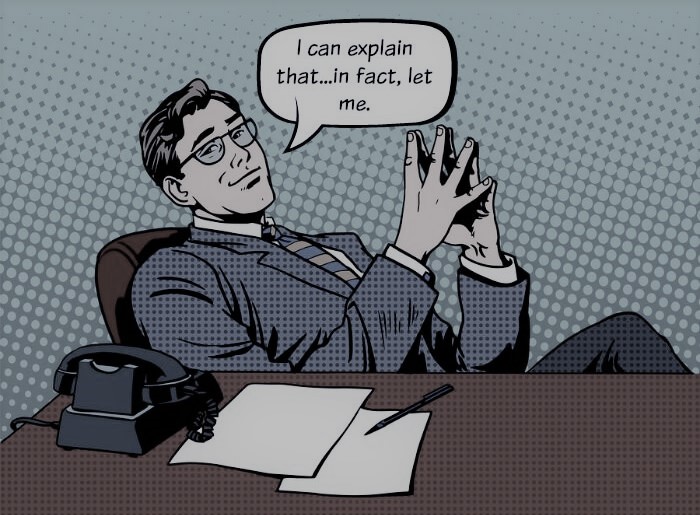
This is not a blog post about mansplaining, but—I have to admit— I think I was born on Rebecca Solnit’s archipelago of arrogance . “Stop explaining. Nobody cares” is my own blunt edict to check myself lest I start unloading unsolicited explanations on unfortunate bystanders.
Paraphrasing Teddy Roosevelt: No one cares how much you know unless they know how much you care.
There are several ways, then, that the urge to explain is misguided. The explaining that I notice within the conversations of lovers is driven less by a sense of superiority and more by a desire to repair a rift. Our hearts are in the right place! Dr. Marjorie Schuman says, “The psychological need to be understood is universal and basic to who we are as human beings” and likely bears upon this instinct to explain. The single most important thing Oprah learned from talking to people daily for 25 years was “a common denominator in our human experience: We want to be validated. We want to be understood.” So true. In our love relationships, we explain to regain understanding at moments when we’ve lost it—you know the ones—those moments when your baffled partner utters their version of “What the?!” Explaining ourselves is a defensive reflex to the emotional whack from our partners that they feel confused, hurt, or angry about our behavior. We explain to get back into their good graces—to regain their approval.
Example:
Jamey: Hello? You’ve been saying you were coming to the dinner table for ten minutes. It’s getting cold.

Quinn: I’m coming, geez, I’m registering us for that 5K you want to run.
Jamey retreats to the dinner table to eat alone, crestfallen by an explaining response that appears to brush off both dinner and Jamey’s feelings. When Quinn eventually shows up, Jamey has adopted the stance of polite civility, a layer of frost descending over the already cooling dinner.
If you relate to this unpleasant dynamic, consider a two-step alternative to the quick urge to explain:
1. Ask yourself, “How is my partner feeling?” and “Why are they feeling that way?”
2. If you understand what they are feeling, express that.
Example:
Quinn: Thank you for making dinner. Of course, you don’t want the food to get cold; I get it.
From here, notice how your partner responds. There is a good chance you will notice cues of a softening, a sense of relief. A small smile, maybe. You might even be given an opening to share your experience.
Jamey: What are you doing anyway?

Quinn: I’m registering us for that race you want to run next month. I thought it would only take a minute but the site is glitchy and I don’t want it to time out.
Waiting for that opening in which to explain significantly increases the likelihood that you will get the validation you need as well.
Jamey: Oh. Well, I hate electronics at the table, but just bring it, it’s fine.
The conversation is about eating dinner but underneath it is about being valued and having the approval of our lover, something we all deeply desire. The moment Jamey expressed disapproval of Quinn’s behavior, Quinn’s urge is to explain in order to win back Jamey’s approval. In your relationship with your partner, start to notice that urge and learn to put it on the side table—not to be ignored, not to be swept under the rug—but just to be on standby for a moment while you validate your partner’s feelings. Then, pick up your own feeling of insecurity and need for approval— your own need to be valued and understood—and get that need met. It will go much better now that you have met your partner’s need. Think about it: when I seek to explain, I invite my lover to empathize with me. But that invitation is mis-timed when it is issued right after my partner has expressed hurt or frustration. At that moment, they need me to prioritize their feelings and needs above my own. Practice setting your own feeling aside for a wee moment, and— straight away—go ahead and empathize with them.
This strategic, interpersonal move is not new or relegated to our intimate relationships. For example, it is Habit 5 in world leader Franklin Covey’s The 7 Habits of Highly Effective People: Seek first to understand, then be understood. It is wisdom, in fact, that can be traced back to the prayers of saints in the late 1100s
let me not seek as much
to be consoled as to console,
to be understood as to understand,
to be loved as to love
The injection of empathic validation at the outset sets up the interaction for success with conflict-resolution, which may be where the conversation is headed, whether it be problem-solving, compromise, or an exploration of feelings and needs.
On the Flip Side
If you are the partner tired of hearing explanations (sometimes labeled as excuses), consider your own part of the cycle. Remember, the explanation is a defensive reflex, triggered by you. It is well-meaning, issued by a partner who wants you, who wants your approval. Your partner’s deep emotional need is to be held in the warm, accepting space of your love. The moment you express upset with them, they feel unsettled. Your efforts to express your feelings while maintaining a warm, loving space will help your partner respond with empathy rather than excuses.
For example, what if Jamey had started with Quinn by saying
Jamey: I’m sure what you are doing is really important but I have spent time making dinner that is getting cold.
Any way of hashtagging your emotional expression with some version of you-are-okay or I-love-you can help your partner offer you validation from a place of secure connection.
Explaining ourselves
is a defensive reflex to the
emotional whack from our partners
that they feel confused, hurt, or angry
about our behavior. We explain
to get back into their good graces—
to regain their approval.
There is something else that partners in Jamey’s shoes may want to check: the ratio of positive to negative comments made to our lover. We want to ensure that the majority of our initial comments to our partner across a day, a week—whatever—do not shape up in the form of judgment, criticism, or expressions of negative emotion. We want most of our initial comments to our partner to be positive or at least a balance of positive and neutral. If you ascertain that the majority of your comments to your partner have a negative tone, nice job in noticing that and being honest with yourself: You have just identified one reason for your partner’s defensive reflex. Now it is time to work on the ratio of positive to negative.
The Take-Away
The next time you start to launch an explanation, pause and challenge yourself to express empathy first. If you are the partner who is tired of excuses, make sure you are offering the initial expression of your feelings within a space of safety, warmth, and love, which is something you are building with every surrounding interaction as well.
It’s only natural that there will be times of confusion and hurt in human love relationships. Fortunately, long-term intimacy affords us the opportunity to learn how to soothe each other at those times. Whereas explaining is always a card in your hand, play empathy first this month and see how it changes the game.

About Me
I’m Kristen Stone, a licensed clinical psychologist, behavioral sleep specialist and couple therapist with a passion to protect and grow empirically-based wellness services through training, research, and innovation. A born and bred southerner, I have found the Northeast a gracious host of my life and work for over 15 years. New England summers, falls, and– yes! –winters are magical. Then Tennessee springtime calls me home.
Subscribe to My Blog
Enter your email address and click “Sign Up” to get new content delivered directly to your inbox.
 Kristen Stone, PhD