

From not talking enough to talking too much, which way do you think I lean?
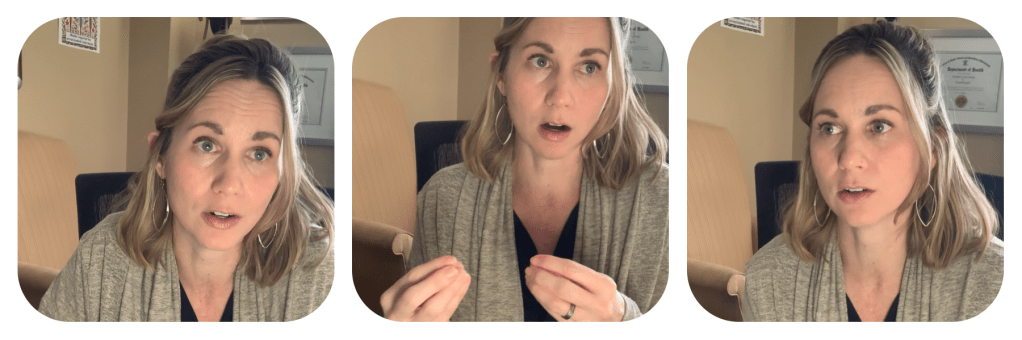
Hint: I once had a boyfriend who wrote a short story in which one of the characters talked incessantly during phone calls, a character based on Yours Truly.
How do I know this? He asked me to read and edit the story. “Dude, is this me??” I asked. Needless to say, I developed a complex and barely say peep on the phone now. (Self-conscious much?)
Of course, I’m dating myself. Talking on the phone is a lost art. Having never mastered it, I say au revoir.
Letter writing, especially love letters, however, is a different story. Writing letters afforded us the time and space to construct and own our stories, essential to our sense of self. Tragically, it seems the letter-writing ship has sailed, and I could weep over this loss for our younger generations. But conversation is not dead and worth saving. So, while we still have time, let’s make a communal effort to preserve and practice this diminishing art that is key to human connection.
Yes—back to the original question—I swing verbose. Admitting this allows me to acknowledge and embrace the idea that conversation is, indeed, an art. One that I have worked to refine. I venture, in fact, that even the most charismatic and charming of all conversationalists have devoted some degree of effort and self-awareness to the enterprise.
The most intense work on my own bad conversation habits occurred in graduate school. I distinctly remember the moment I realized I needed an intervention. I was talking. A lot. Rapidly. To a peer. I realized I was nervous, not sweating-nervous, just a mild current of internal activation. I suddenly wondered how I had let so much time go by, so much life lived, without addressing this. I had work to do. I became a scientist of myself for a period and identified that I talked too much when I was nervous and when I was passionate. I identified that I was typically nervous when I was talking with someone I did not know (but respected) and when I was talking with someone whom I perceived as shy or quiet. I realized with the latter that I was nervous for them— that I was assuming they were not saying much due to their own nervousness and so I was heroically (annoyingly, unnecessarily) jumping in to alleviate their burden. I also identified that I didn’t let people finish their sentences when I was nervous. A lot of observations for someone who so recently had been totally unaware of a completely predictable nervousness that showed up in specific contexts.
With this new insight I developed my goals, which included
~ Bringing self-awareness to conversations with others, especially people I didn’t know well or people who didn’t say much.
~ Slowing down and pausing. I intentionally challenged myself to allow short moments of silence before I responded during conversational turns.
~ Not interrupting and if I did, stopping myself and saying, “I’m sorry, please continue.”
I worked and worked and worked. I became comfortable with silence, something I had always loved when alone but loathed when with strangers and acquaintances. I took a lot more deep, clarifying, grounding breaths during conversations. I found my calm center. The result of all this work was that I started truly enjoying conversations with acquaintances rather than merely moving through them glazed over and halfway holding my breath.
If, like me, you are never short on words, or if you feel nervous for the opposite reason (i.e., you worry you will not know what to say) engage in your own self-study.
1. Just notice what you do and write it down. Keep your own conversation log for one or two weeks:
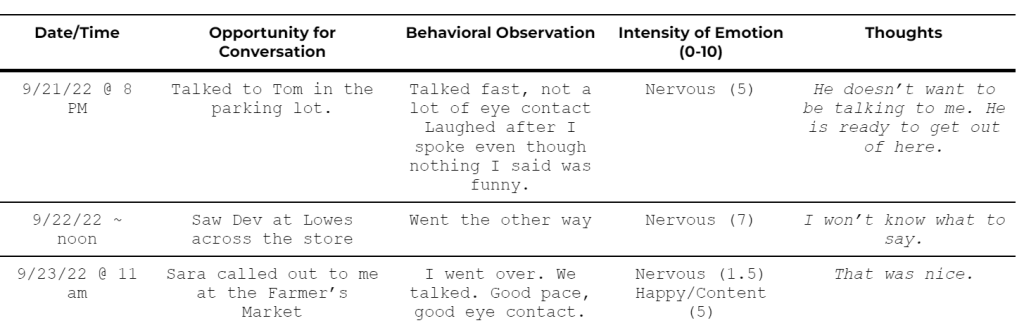
2. Review your log and look for patterns.
3. Develop your goal (or goals).
4. Get to work!
While you are working to meet your goals, log your successes. (Do not skip this. Do it for at least one week.)
If you are a person who is working to say more in conversations, an example of a goal might be, At least once per day go ahead and say out loud something that, typically, I would filter. So, whereas I am often coaching myself, “Kristen, you don’t have to say that. Don’t say it; Leave it unsaid,” you would be working on the opposite, “You can say that. Go ahead. Share that thought.” Log these successes as well as the response from the other person (and your feelings and thoughts if you would like). My hope is that you notice how valued and appreciated your contributions are to the conversation, that your genuine ideas, stories, and input draws people closer to you. My hope is that through your own self-study and intervention you will have more rewarding conversations that enrich your life.
As a talkative person, I am often coaching myself to

Leave it unsaid.

Once I do, there is often a feeling of discomfort to notice and explore, a feeling that is important for my self-growth.
 For someone else it might be the opposite. He might coach himself to

Say it. Share your thought.

Once he does, he will notice a feeling of discomfort that is worth exploring and important for his self-growth.
However you assess your conversational abilities and challenges, generally the following qualities serve all of us well:
~> Be willing to listen. Listening is hard when nervous, one reason it is important to learn how to find your calm center, with practice and over time.
~> Be willing to share. If yours is a thick filter and you are working to let more thoughts through, this will be about taking risks. Be proud of yourself for speaking up, regardless of the outcome.
~> Be curious and interested. Again, hard when we are nervous as it requires focus on the other person, not ourselves. Practice asking questions as a way to foster your curiosity.
~> Be attuned. As you are focusing on the other person, you’re noticing their cues. Allowing for some silence enables you to better gauge the other person’s interests with regard to this conversation. In the silent moment bring your awareness with all five senses to this interaction with this human. Appreciate it anew. This moment allows you the chance to see what shows up for you and for the other person. Would you or the other person like to bring the conversation to a close? If not, where would you or she like the conversation to go?
Conversation is one form of intimate connection. Like with sex, it is important not to put too much pressure on yourself. The act of exploring together makes the connection special; it is a unique moment between you, never to be replicated. Variable quality is part of what makes it fun! Let it be messy. Laugh at the awkward. Don’t expect perfection.
In the comments section below, please share your own observations, tips, and the things you enjoy the most about conversation. Any funny stories? Let’s learn from each other as we continue to craft this ancient, exquisite art that bonds.

About Me
I’m Kristen Stone, a licensed clinical psychologist, behavioral sleep specialist and couple therapist with a passion to protect and grow empirically-based wellness services through training, research, and innovation. A born and bred southerner, I have found the Northeast a gracious host of my life and work for over 15 years. New England summers, falls, and— yes!—winters are magical. Then Tennessee springtime calls me home.
Subscribe to My Blog
Enter your email address and click “Sign Up” to get new content delivered directly to your inbox.
 Kristen Stone, PhD
One Reply to “”