

LOVE WELL PEARL # 3
      "Something else happened the year Derrick went off to college. While their bedroom life had slowed considerably, Harmon had accepted this, had sensed for some time that Bonnie was 'accommodating' him. But one night he turned to her in bed, and she pulled away. After a long moment she said quietly, 'Harmon, I think I'm just done with that stuff.'
     "They lay there in the dark: what gripped him from his bowels on up was the horrible, blank knowledge that she meant this. Still, nobody can accept losses right away.
     "'Done?' he asked. She could have piled twenty bricks onto his stomach, that was the pain he felt."

Elizabeth Strout, "Starving"
Olive Kitteridge pages 82-83
“We all know on some deep, visceral level how much we need others,” renowned leader in adult attachment and long-term love Dr. Sue Johnson said, “The strongest among us can accept that and learn how to connect.”
If we are strong, we can accept
how much we need each other
and learn how to connect.
Whether you are considering bringing sex back into your long-term relationship or are on the verge of letting it go altogether, read on. Flirt for a few minutes with the idea of revitalizing your monogamous sexual relationship in your quest to deepen and enrich your life. This magical, messy, mesmerizing part of the human experience may feel complicated, yet may be worth your hustle.
Your Health
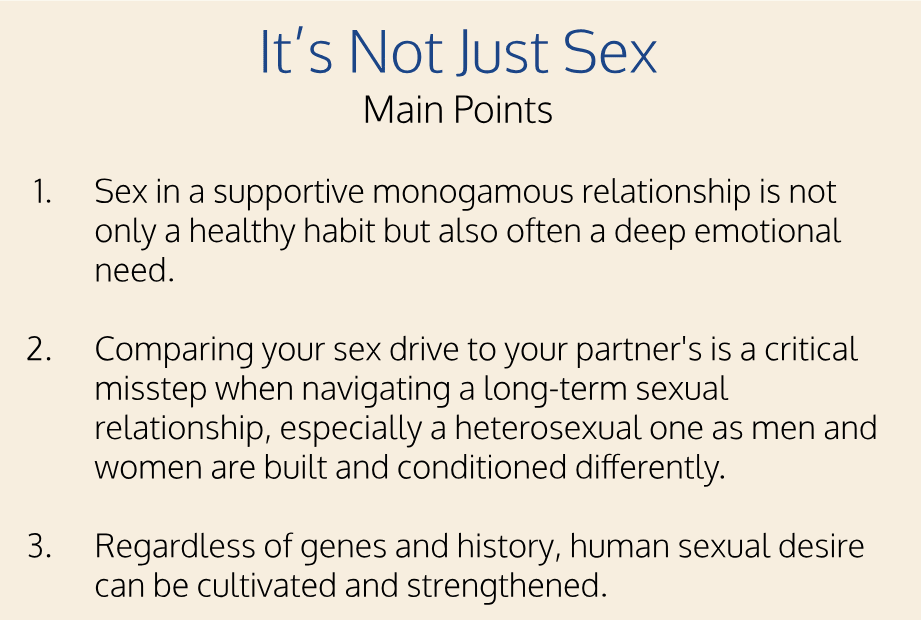
Sex creates positive physiological, relationship, and health effects.
1. Sex is associated with
~decreased cortisol and adrenaline, linked to stress, fatigue, and increased blood pressure
~increased endorphins, oxytocin, and prolactin, which foster feelings of satisfaction, relaxation, and sleep.
2. Sex is capable of fast-tracking emotional connection. Married life can be hectic with the competing demands of work, home, family, finances, and illness. Finding each other under the covers can become a secret indulgence you share that makes life easier. Give yourself permission to ditch the “I should only have sex if” schema at the intersection of long-term monogamy and adulthood. You get to have sex whenever you want. You make the rules. Society, old messaging, what-would-people-think, and even your criticism of yourself or your mate do not have to come to the party. You can sneak away from those influences and have sex anyway. Sex is for you—to experience pleasure, belonging, and bonding. See if you can reconceptualize it as such if, at this point in your marriage, it has become something else (e.g., something I never do enough, something I’m failing at. . . Of course you’ll avoid it if that’s what it has become!). Sex is like the Advance to Go and Collect $200 of marriage and you don’t have to wait to draw a Chance card to do it.
3. Monogamous sex is associated with long telomeres, which help prevent degenerative disease and are associated with decreased risk of heart disease in older women. Sex may also decrease cancer risk especially in the reproductive and endocrine systems, increase pain threshold, and improve immunity and bladder control.
Sex, in a sense, in part, is a physical health practice that you committed to when you committed to your long-term lover. It is a practice that takes diligence, partnership, choreography, planning, designing, studying, conversing, bravery, and vulnerability—none of which, by the way, we knew when we signed up for this! We certainly didn’t learn the truth of long-term sexual partnership watching movies as kids. Rather, we were sent the opposite message. All the rom-coms and Disney movies ended with marriage; long-term sexual partnership was the blissful happily-ever-after. Even without informed consent, however, we may become enticed by all that this healthy “physical practice” has to offer.
Your Mind
Whereas my last blog post dealt with the common frustration in relationships associated with partners’ differing levels of desire for conversation, the flip side of that coin is frustration associated with partners’ differing levels of desire for sex. Frustration resides not only in the heart but also in the mind, leading us to wonder: Are there assumptions leading to this frustration? Do I believe that my partner’s need for sex is something he can shut off (see “Your Mate” below) or that, conversely, my partner should desire sex as much as I do?
First, to avoid overgeneralization of gender and sexuality, let’s get this out there:
~Sometimes men don’t want sex, which is normal.
~Sometimes women have higher sex drives than their male partners, which is also normal.
Vast individual differences aside, men have a higher sexual desire than women overall (Baumeister et al, 2001; van Anders, 2012). So, for all the straight fellas comparing her sex drive to yours, lower than yours doesn’t mean abnormal. For all the straight women expecting him to be able to turn off his sex drive, he couldn’t even if he tried.
Dr. Rosemary Basson’s research normalized women’s sexual experience by revealing that women most often do not experience spontaneous sexual desire as shown in Hollywood movies. We are not typically aroused at the outset of the encounter; for us it usually happens during. She also found that men’s sexual desire is similarly responsive (rather than spontaneous as previously assumed) although time to sexual arousal from exposure to the cue is shorter for men, who are more visually stimulated. Check out Sarah Barmak’s article, The Misunderstood Science of Sexual Desire, which describes Dr. Basson’s revolutionary work. Lack of spontaneous desire, in short, is not a sign of dysfunction but rather a gentle nudge to downgrade your status from mythological goddess to mere mortal.

Understanding normal healthy human sexual desire helps correct our false notions of brokenness. It is a starting place for opening our minds to a wider landscape of sex, beyond the limits of cinema, in which we can find ourselves. It is a starting place for believing sex is expansive enough to include you—yes, you—your pleasures, your joy, your ecstasy, and your comfort.
Your Mate
“It’s not just sex.”
I hear this frequently in couple therapy sessions, mostly from men. There are so many ways in which they try to say, “I want you to want me,” “I want to be close to you,” and “When we are having sex it helps me feel securely connected to you.” Sex may be one of the deepest emotional needs of your partner. In my last blog post, I encouraged lovers to step out of their comfort zones and talk to their partners—be willing to cultivate connection outside the bedroom. Now, we look inside the bedroom (or the kitchen or shower or. . .you get it) for another kind of connection. If you feel more secure in your relationship when you are emotionally connected to your partner through intimate conversation, take a moment to recognize, if your partner is desiring sex, they are yearning for the same emotional closeness. They may be built and conditioned to yearn for sex as a means to that closeness the way you may be built and conditioned to yearn for nonsexual affection and attention. Empathize with your partner, recognizing the base need for closeness is the same. You need and want each other—mind and body.
It is intuitive to think my own needs are more important whichever way that goes, that sex is more important than nonsexual connection or vice versa. It is also intuitive to focus on what I’m not getting from my lover instead of on what I’m not giving.
It is intuitive to focus on
what I’m not getting from my lover
instead of on
what I’m not giving.
Taking a step back, though, I can acknowledge that my partner’s deepest needs are as important as mine. Even if it’s sex and even if I’m a product of a society that shames, jeers at, and even demonizes (e.g., “perv”) sexual neediness. We’ve all overheard or been a part of making fun of men for their insatiable sexual desire.

If you’ve been frustrated by your partner’s need for sex or if you’ve simply deprioritized your partner’s sexual needs, what are the costs of this struggle in your relationship? How is your partner feeling and behaving as he or she is not getting their needs met? Sex is deeply emotional, psychological, cognitive, spiritual and the list goes on. Jokes aside, we’re not serving our relationship when we dumb it down to a meme (even though they are pretty funny. Okay, just one more. . . )

Sex matters. How you respond to an invitation to have sex matters. Sue Johnson says, “In the end, what none of us can bear is the feeling that we’re alone and that we don’t matter to another human being.” Not expressing sexual interest in your mate can make them feel that they don’t matter the same way not expressing emotional interest in you might make you feel that you don’t matter. What is your lover yearning for? What’s holding you back from giving it to them? “Passion is about feeling safe enough to be completely absorbed in the experience and let it take you over,” Sue Johnson tells us. “Passion is about full engagement” whether physical or emotional. Sure, you probably have a greater familiarity with initiating either physical intimacy or nonphysical emotional closeness. The trick to being an engaged lover is willingness 1) to be responsive when my lover initiates intimacy in either form and 2) to practice initiating the form of intimacy with which I’m less familiar and less comfortable. Am I willing to learn new things for my lover? Am I willing to learn how to initiate sex? Am I willing to learn how to get in the mood? Can I talk about these things with my lover even if we never have?
Long-term love is for the brave.
Yourself
The question— I often tell my clients— isn’t whether you want to have sex; it’s whether you want to want to have sex. If my client says yes to the latter, game on. For a lot of women, it is about a willingness to develop our sexual selves. For our lover. For our marriage. For ourselves. We women aren’t necessarily encouraged or guided in the development of a sexual self. Were you? Did your society or community send you messages that it was okay to think about sex, to imagine yourself sexually aroused, to explore your body, or to embrace your sexuality? No? Then, firstly, give yourself a break if you aren’t the sexual vixen your husband desires. Secondly, ask yourself if it is time to grow into a richer, fuller version of yourself, one that is attuned to sensual and sexual desire, fantasy, and preferences. Who can support you? Who can you talk with about this journey? Role models, mothers, aunts, grandmothers? Friends? Your mate? Your therapist? My girlfriends and I once made a pact that we would have sex with our husbands on Christmas Eve. Yup. I know. . . who, with young children, is not COMPLETELY EXHAUSTED by Christmas Eve?

Yet, packing my bags and tucking the stupid, fluffy red Santa hat into my suitcase, I felt schoolgirl giddy with my secret plan of unexpected seduction. Another time I learned a striptease with two different girlfriends with the understanding that our husbands were our target audience. These examples underscore three points:
1. Our partners’ needs are as important as ours (and maybe more important than our children’s need for more toys)
2. If my person is MY PERSON, the one with whom I feel safest, I have to take some leaps to feel the depth of that bond and
3. When doing hard, vulnerable things, having support, encouragement, and accountability helps a ton!
A few notes:
Fellas, cultivating her sexual desire is not all her job. Have you ever seen the Bird-of-Paradise doing his mating dance? YouTube it and prepare to be inspired. Do not let marriage or the sheer longevity of your relationship breed a false perception that courting your mate is no longer required. As noted, a wealth of research backs up gender differences in sex drive; piquing her interest will always be part of the dance. Also, keep in mind that women’s sexual cycles start well before men’s (i.e., putting away the dishes before she gets home is foreplay!).

For those working to develop or strengthen their sexual selves, if your partner is of a more critical nature, it’s okay to ask for 100% praise and 0% criticism to best support your growth.
Imagine you really wanted your partner to care about fitness, which wasn’t something they were encouraged or supported to do in their life before you; they had never developed that habit or that part of themselves. But it really mattered to you. They could work on it, right? Even hire a personal trainer? Same here. A sex therapist isn’t out of the question, especially if you are feeling some tough blocks to developing your sexual self. A therapist can help! Importantly, give yourself credit for anything and everything you do to develop this part of yourself, whether it be to create a fun dare or challenge for yourself, read a sex book, talk to a friend or family member about sex, or hire a sex therapist. Go you! Hopefully, this can be an invigorating avenue of personal growth.
What will it take for you to let yourself Advance to Go? If we’re strong, we can accept how much we need each other and learn how to connect. Accept, learn, be strong, and give yourself credit every step of the way.

About Me
I’m Kristen Stone, a licensed clinical psychologist, behavioral sleep specialist and couple therapist with a passion to protect and grow empirically-based wellness services through training, research, and innovation. A born and bred southerner, I have found the Northeast a gracious host of my life and work for over 15 years. New England summers, falls, and—yes!—winters are magical. Then Tennessee springtime calls me home.
Subscribe to My Blog
Enter your email address and click “Sign Up” to get new content delivered directly to your inbox.
 Kristen Stone, PhD